Key Takeaways

What is the focus of the Trend Study Care & Social Affairs 2026?
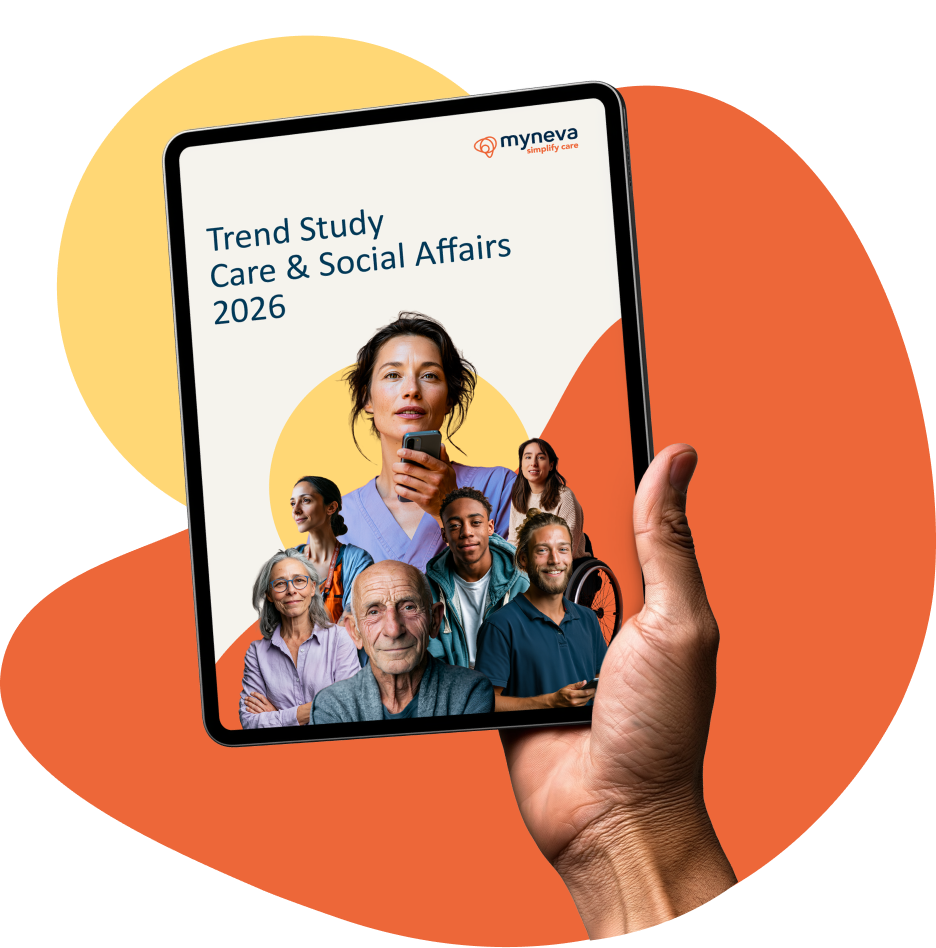
With the Trend Study Care & Social Affairs 2026 myneva is examining for the third time how professionals in the social sector experience their day-to-day work and what role digital technologies play in it. While the 2024 and 2025 studies primarily focused on the state of digitization and expectations for digital solutions, the 2026 study centers on their impact. The study examines how the time saved is utilized and how digital solutions contribute to reducing the workload and improving the quality of care.
To this end, the independent polling institute Civey surveyed 3,525 professionals from seven European countries on behalf of myneva. Their experiences form the basis for a fact-based discussion about the future of care. In 2026, the focus is thus on the next step in the evolution of digitized processes – toward digital assistants that support professionals in their daily work – and on the extent to which these assistants can truly alleviate the workload in everyday care settings.
How do professionals look at digitalization?
One positive development is that digitalization is advancing. Across Europe, 60.3 percent of respondents report using digital solutions frequently or very frequently in their day-to-day work. At the same time, gaps remain: Only 49.2 percent use mobile applications. This means there is still potential, particularly in areas where information is recorded directly during care and where additional work steps could be avoided through manual data entry.
It is also surprising how differently professionals assess the benefits of digitalization. Experienced professionals, particularly those between the ages of 40 and 50, see it as an important tool for helping new professionals enter the workforce and for overcoming language barriers faced by international professionals.
Younger people who are just starting their careers are more cautious in their assessment of this potential. One possible explanation lies in their expectations: For the younger generation, digitization is already a natural part of everyday work life. Experienced professionals, on the other hand, are familiar with existing processes and can see more clearly where digital solutions can provide support and create lasting relief.
“It’s surprising that young people see less potential in digitalization. For them, digitalization is already the norm, and they don’t realize that the care sector may be ten or twenty years behind. Experienced professionals, therefore, have a clearer understanding of the potential that digital support offers in everyday life.”
Dieter Weisshaar
What happens to the time saved in day-to-day care?
Across Europe, 80.6 percent of respondents report that the time they save is immediately taken up by other tasks. This highlights the high work pressure within the system. Therefore, time savings do not automatically lead to a reduced workload.
The time saved translates into both quality and efficiency: better documentation, more personalized care, and a reduced workload for staff, but also into additional tasks. In outpatient care, for example, more clients can be cared for during a single round. In inpatient care, however, staffing standards apply that do not allow for changes in staffing levels even when there are more clients. For inpatient care, this highlights the question of how the time saved can be used to improve care within the existing workforce.
Digital solutions also improve the reliability of care. Across Europe, 58.9 percent of respondents report that digital systems reduce errors in day-to-day work, such as giving medication. The time saved is therefore rarely left unallocated, but it can certainly contribute to higher-quality care.
“About half of the time saved goes toward efficiency, and the other half toward higher quality, error prevention, and stress reduction.”
Dieter Weisshaar
What makes it difficult to use mobile applications?
Across Europe, 50.8 percent of respondents do not use mobile applications in their daily work. At the same time, the contribution of mobile documentation to quality is rated similarly highly in both areas. While its benefits are recognized, they are still too rarely leveraged in everyday work.
One obstacle is the lack of technical infrastructure: for example, many inpatient long-term care facilities do not yet have Wi-Fi. As a result, many locations lack an essential prerequisite for capturing information on mobile devices directly during care.
Added to this is a lack of investment incentives. Staffing guidelines often do not take into account whether facilities still use paper or have already switched to digital assistance. As long as budgets and guidelines do not reflect this difference, investments are difficult to justify economically, despite the potential for reduced workload.
In Germany, the draft of the Care Reform Act (Pflegeneuordnungsgesetz, PNOG) provides for new funding flexibility in this regard. Full-time inpatient facilities shall be able to use the financial equivalent of certain unfilled staff positions to fund technical and digital systems that provide support or reduce the workload. The provision allows for up to 10 percent of staff positions between the minimum and maximum staffing levels. In addition, funding programs outside of regular operating budgets can facilitate such investments.
How can the use of AI support day-to-day care?
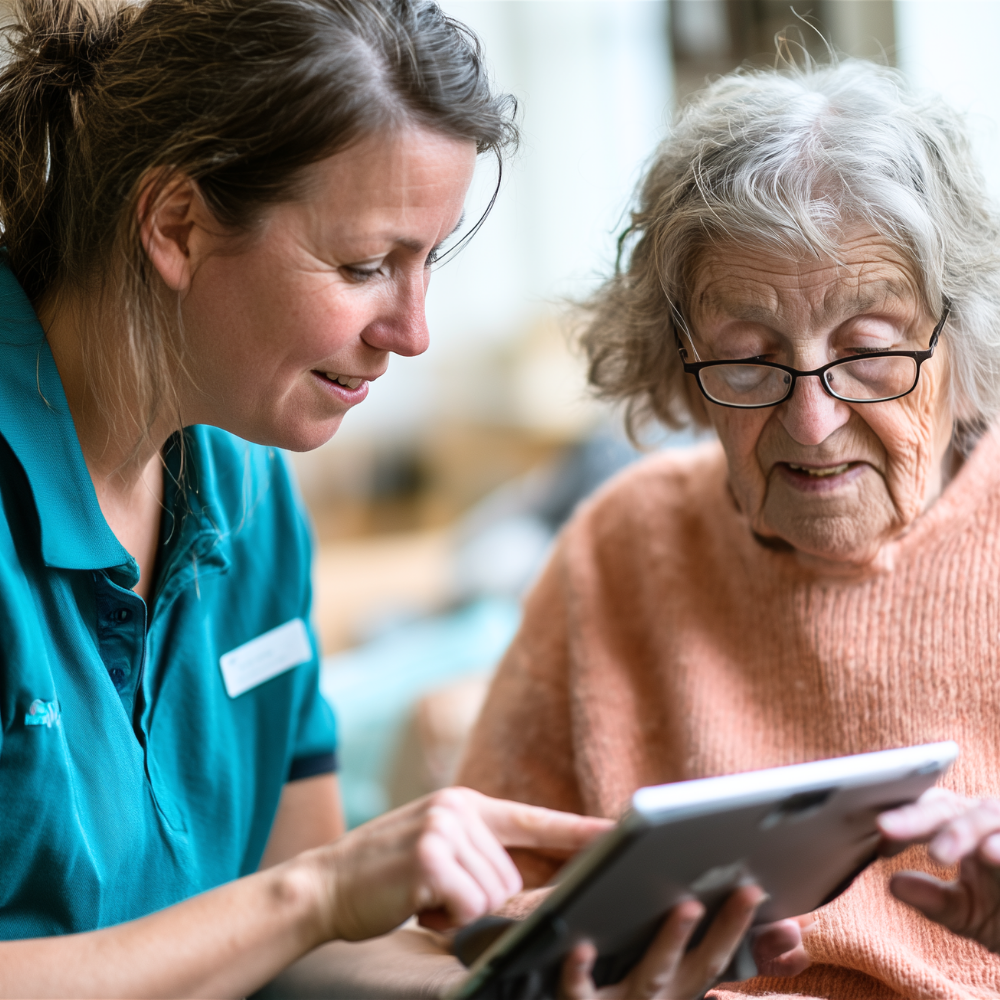
Only about half of the professionals surveyed feel sufficiently equipped to use AI in their day-to-day work. As with the introduction of any new technology, changing this situation will require effective training.
Anyone who communicates with the IT system using voice recognition in the future will have to change the way they’ve been working. This new approach must be practiced and supported by concrete guidance. This also includes clearly explaining what happens to the data that is collected.
Organizations and providers such as myneva have a responsibility to prepare employees for the use of AI-supported solutions. On-demand video training can supplement in-person training. It helps employees review individual steps directly at the point of care whenever needed.
At the same time, AI-supported solutions must be as intuitive to use as possible. That is why myneva is working to make the user interface so simple and intuitive that it requires as little training as possible.
What does it need for digital solutions to make everyday life easier?
Across Europe, 63.8 percent of respondents see a need for digital support that provides them with the right information at the right time. For this support to be effective in everyday life, systems must be interconnected and exchange information seamlessly.
This can be seen in the example of speech recognition. The technology has long been established on the market, and there are numerous voice-supported documentation systems available. However, if the recorded content must then be manually transferred to the core software, it creates additional work, and the desired reduction in workload will not be achieved.
Digital assistants must therefore operate seamlessly and be fully integrated into the existing software environment. For example, vital signs can be recorded directly at the point of care. A professional reviews and confirms the data and automatically transmits it to the core software. This eliminates the need for additional manual data entry.
Given the need for international professionals, this also includes AI-supported translation. It must be possible to capture information in different languages and, after review, make it available in the documentation system in the language of the respective organization. Workload is reduced when these steps are seamlessly integrated, eliminating the need for additional conversions and media breaks.
“With the help of digital assistants, it's possible to achieve a 20 percent reduction in workload during an eight-hour shift. That would dramatically ease the burden on our system."
Dieter Weisshaar
What does future-proof care require?
The trend study makes clear that digitalization is already having an impact on day-to-day care, but its potential has not yet been fully realized. Of the average two and a half hours spent on administrative and documentation tasks per shift, digital solutions can already save about one and a half hours.
The next step moves from the digital mapping of tasks to active assistance in everyday life. With prompts, reminders, and specific suggestions, digital assistants help professionals complete their tasks reliably and with less effort.
The technology for this next generation of software is already available. With careful planning, organizations can gradually expand their existing systems to include digital assistance.
This reduction in workload can also help make the profession more attractive again – especially for young people who expect digital support in their day-to-day work.
Want to learn more?
Download our Trend Study Care & Social Affairs 2026 now – featuring exclusive insights from seven European countries!