

Key Takeaways
Digitization in the social care sector: Where do organizations stand today?
Digitalization has reached the social sector, yet many organizations are still in the early stages. According to the myneva Trend Study on Care & Social Services 2025 ¹, just under half of professionals currently work in partially digital environments, while only 18.6 percent have a fully digital, mobile work environment. At the same time, many professionals would like to have digital support in their daily care work.
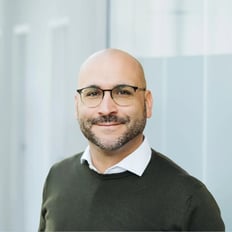
Through his regular contact with healthcare facilities, Sascha Platen sees that many are making progress: “Five years ago, many facilities didn’t even have internet access throughout their premises,” he says. Today, tablets are widely used for documentation, digital tour planning, and sensor-based fall detection. Communication in the healthcare sector has also changed significantly: “In the past, you had to print out documents and hand them over. Thanks to telematics infrastructure (TI), everything can eventually be transmitted digitally.”
And yet this is only the beginning. “We’re probably only 20 to 25 percent of the way there,” says Sascha Platen. The next step in development is to capture documentation not after the fact, but directly at the point of care via voice input. Digital communication channels are just as urgent. “I’ve seen care facilities where employees message each other via Facebook Messenger. Of course, that’s neither compliant with data protection regulations nor particularly practical,” says Sascha Platen.
In his view, the untapped potential lies in the consistent use of digital assistants that run in the background and help ease the workload of professionals in their day-to-day work.
„There is one hope we must let go of: that bureaucracy will decrease.“
Sascha Platen
Between optimism and overwhelmed: The key challenges for facilities
Despite the availability of digital solutions and a growing openness to digitalization, the path to digitalization in organizations remains challenging. In practice, Sascha Platen identifies three main obstacles:
-
Funding:
Many organizations are under financial pressure. Rising salaries and limited budgets leave little room for investment in digital infrastructure. As a result, digitalization is often viewed as an additional cost rather than a strategic investment in the future.
-
Lack of orientation:
The market for digital applications is growing rapidly. There is a wide variety of software offerings and standalone solutions, some of which vary significantly in quality. Decision-makers are often overwhelmed and face the challenge of identifying suitable, sustainable solutions.
-
Increasing system complexity:
Instead of holistic platforms, isolated solutions often emerge. Processes are digitized but not designed with integration in mind. Different systems and a lack of interfaces increase the coordination effort and create additional work due to partial digitization.
2028 as a turning point: What is the significance of the new digitalization strategy?
With its new digitalization strategy for healthcare, the German federal government is focusing on the systematic expansion of telematics infrastructure, the greater integration of artificial intelligence (AI) into care processes, and financial support mechanisms to facilitate implementation in care facilities. The goal is to ensure that digitalization is no longer optional but rather becomes a structural component of care.
For Sascha Platen, this political initiative is more than just an announcement of reform: “In my view, this is our last chance – and one of the most reasonable things I’ve seen so far.” Over the past ten years, wages have been raised, structures have been adjusted, and outpatient models have been strengthened – yet the shortage of professionals persists. “The only solution left is digitalization,” says Sascha Platen.
The target year of 2028 is no coincidence. Many caregivers are already over 55 years old, and a massive decline in the workforce is looming in the coming years as they enter retirement. “If we fail to consistently digitize processes and make them more efficient by 2028, the system faces the threat of structural overload that will be nearly impossible to manage.”
At the same time, practical examples show that digitalization can make a real difference. Sascha Platen reports on organizations that have been able to offset sick leave and significantly reduce staff overtime using digital solutions. If digitalization is implemented consistently, there is a realistic chance of remaining capable of providing care with the current number of employees, even under more challenging conditions.
Best practices: What matters most for facilities right now
A strategic framework has been established; what is now crucial is its implementation in the facilities. From Sascha Platen’s perspective, this is less about additional projects and more about a clear understanding of digitalization: it should ease the workload, not overwhelm staff.
What facilities can do now:
-
Focus on process integration
When introducing digital systems, it is crucial to select and implement solutions that integrate seamlessly into existing workflows. This helps avoid the extra effort caused by siloed solutions and media breaks.
-
Making Active Use of TI
TI is more than just a legal requirement – it forms the foundation for integrated care. Facilities that are fully connected benefit from secure data exchange, faster processes, and structural integration into the digital healthcare system.
-
Developing an open mind towards artificial intelligence (AI)
When used correctly, AI can take over routine tasks and significantly ease the workload. Sascha Platen sees great potential, particularly in speech-to-text documentation, to save time and make processes more efficient.
-
Define time as a key metric
Every decision regarding digitalization should be evaluated based on a simple question: Does it save a noticeable amount of time in day-to-day care?
How does myneva support organizations as a strategic partner?
In a market flooded with providers of digital solutions, what matters most to Sascha Platen isn’t who offers the most features, but who makes a tangible difference. That’s how myneva measures its success: by every minute saved.
For years, caregivers have been primarily occupied with navigating a system characterized by bureaucracy and overwhelming workloads. That’s why myneva’s digital assistants step in exactly where time is lost – such as in documentation or communication with family members. This requires end-to-end process integration. myneva relies on interconnected structures where systems work together seamlessly, providing tangible relief in daily work routines.
For Sascha Platen, myneva’s mission is clear: “Every minute we can save is valuable – so that professionals can do what they chose their career for: working with people.“
“Every minute we save helps boost the intrinsic motivation of caregivers.“
Sascha Platen
Outlook: What might the social sector look like in three to five years?
One thing is certain: the coming years will be a stress test for the system. Demographic pressure is rising, while at the same time demands for quality and documentation are growing.
To ensure that personalized care can still be provided in three to five years, facilities must act now. Consistently implemented digitalization reduces the workload on professionals and increases the likelihood of retaining them in the profession. At the same time, it makes the profession more attractive to a generation of digital natives who have grown up with digital systems.
Sascha Platen has a clear hope for this: “If this succeeds, I dream of care facilities where caregivers come to work motivated in the morning – and can say in the evening: “I wasn’t overworked today.’”
How digital assistants ease the workload of professionals
Learn how organizations simplify processes and save a significant amount of time in their daily work.
.webp?width=634&height=422&name=myneva.care_speech%20to%20text%20function%20(5).webp)

.webp?width=1000&height=667&name=iStock-2103970739-1%20(2).webp)